
 MAP
MAP SEARCH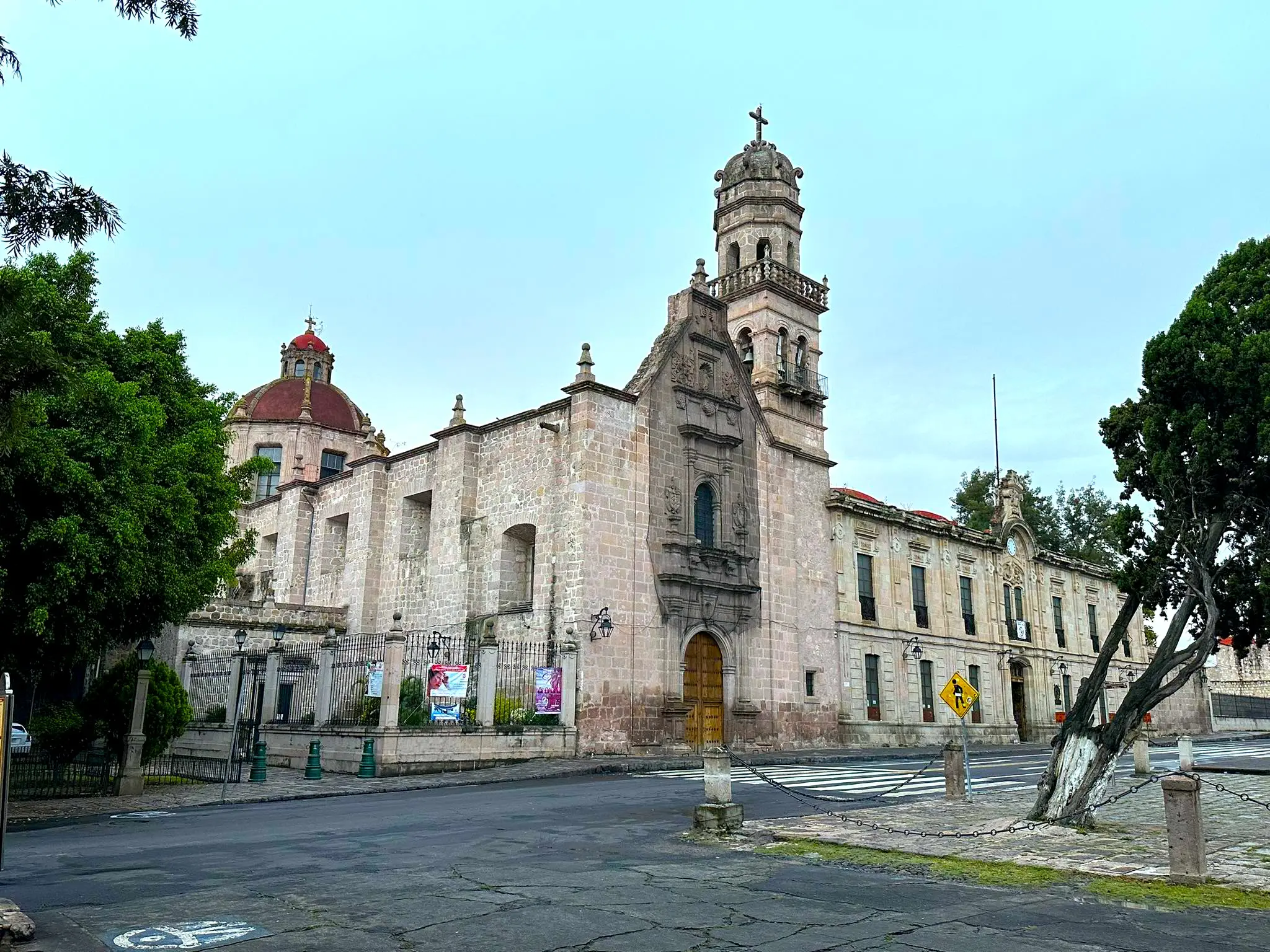


Adress
Av. Tata Vasco 45-3, Centro, 58230 Morelia, Michoacán, México.
GPS
19.700839511125, -101.17743551731
Phone
Send an Email to
Web
Monday
08:00 – 19:00
Tuesday
08:00 – 19:00
Wednesday
08:00 – 19:00
Thursday
08:00 – 19:00
Friday
08:00 – 19:00
Saturday
08:00 – 19:00
Sunday
08:00 – 20:00
KNOW MORE PLACES
VISITA OTRAS LOCALIDADES
⛪ The Hidden Treasure at the End of the Causeway ✨
If you reached the end of the Fray Antonio de San Miguel Causeway, you'll find yourself facing a temple that, from the outside, seems calm and even simple. But don't be fooled. Cross its threshold and prepare to be breathless: the Sanctuary of Our Lady of Guadalupe (affectionately known as San Diego) hides the most impressive and colorful interior in all of Morelia.
Originally built between 1708 and 1716, this venue is an explosion of art that combines faith with the artisanal mastery of Michoacán.
🛡️ The Guardian of the East (The 4 Cardinal Points)
A fascinating historical fact is that, in the 18th century, the old Valladolid was spiritually “protected” by four temples dedicated to the Virgin, located at the four cardinal points of the city:
North: Santa María de los Urdiales.
South: Saint Catherine the Martyr.
West: Our Lady of Mercy.
East: Our Lady of Guadalupe (This Sanctuary).
🌺 The Interior: A Masterpiece of Clay and Faith
What makes this temple unique is not just the gold, but the clay. Between 1907 and 1913, the brilliant craftsman Joaquín Orta Menchaca transformed the interior, covering walls and vaults with thousands of flowers and geometric figures made of baked and polychrome clay. It is a work of infinite patience and dazzling beauty that fuses European technique with indigenous and mestizo craftsmanship.
- Local Pride: Joaquín Orta was originally from Tlalpujahua, Michoacán. His genius lay in fusing the European technique of plasterwork with the indigenous tradition of fired and polychrome clay. What you see is not just decoration, it is the mestizo identity of Michoacán embodied in the walls.
Modern Art: In 1975, the old murals were replaced by works by the master Pedro Cruz, which narrate the arrival and work of the Franciscan missionaries in Michoacán.
☠️ The Cross of the Executed and the Lost Cemetery
As you explore the atrium (the plaza in front of the temple surrounded by iron chains since 1873), you're walking on what was a cemetery until 1859. But the darkest secret lies in the north side garden. There you'll see a octagonal stone cross. According to some historians, this cross belonged to the old municipal cemetery and was the post where they tied up those condemned to death to be shot.. A silent vestige of violent times amidst so much beauty.
⚖️ The Intellectual Neighbor: Former Convent of San Diego
Right next to the temple you'll see an elegant building. It was built between 1761 and 1769 as a convent for the Discalced Franciscan friars. After being expropriated in 1859, the building had many lives: it was a civil hospital, a girls' academy, a venue for industrial exhibitions, and today, since 1967, it is the Faculty of Law and Social Sciences of the Michoacan University. Its halls are no longer walked by monks, but by the future lawyers of the state.
📍 Why visit it from Pátzcuaro?
Because it's the visual climax of your visit to Morelia. There's no other temple like it in the state. Joaquín Orta's decoration will remind you of the rich craftsmanship you see in the markets of Pátzcuaro, but elevated to an architectural level. Tip from Visit Pátzcuaro: Sit on one of the benches inside and simply gaze up. The intricate details of the domes are mesmerizing. It's the perfect place to give thanks for your journey before returning to rest in our magical town.

 EN
EN  ES
ES