
Much more than an emblem
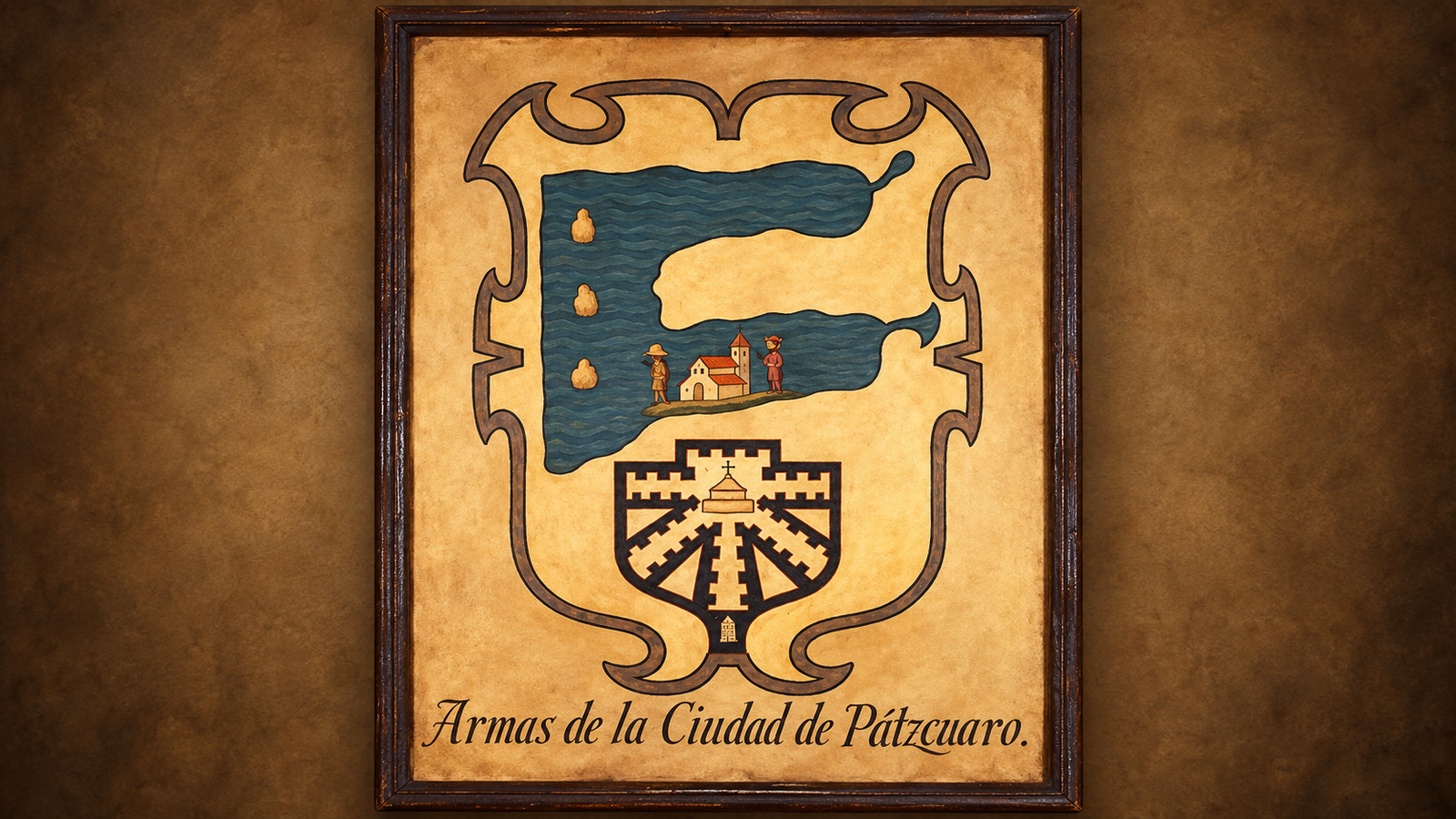
Pátzcuaro's coat of arms was granted by a royal decree dated in Valladolid on July 21, 1553, during the reign of Charles I of Spain and V of the Holy Roman Empire.
But that royal grant did not create the city's status out of nothing.
The title City of Mechuacan had an earlier history. A royal decree of 1534 had recognized that status in the principal settlement then located at Tzintzuntzan. Later, as the episcopal seat and institutions of government moved toward Pátzcuaro, the title, privileges, and documents that supported them also became part of the dispute over the new seat.
When the arms were granted in 1553, the decree was already addressed to the City of Mechuacan. whose seat was then in Pátzcuaro.
That matters because it does not mean that the city came into legal existence on that July 21.
The history —and the dispute— had begun earlier.
In those years, Pátzcuaro, Tzintzuntzan, and the new Spanish settlement of Guayangareo claimed, in different ways, the name, privileges, and status associated with the City of Mechuacan.
The coat of arms formed part of that history.
What the decree says
The description preserved in the file is quite specific.
The grant calls for a lake and “a church upon a rocky outcrop, under the invocation of Saint Peter and Saint Paul”; it then mentions the cathedral church and three other rocky outcrops within the lake. The refrences is Archivo General de Indias, México 1042, f. 43v.
This detail changes an explanation that was repeated for many years.
Saint Peter and Saint Paul do not appear in the text as two figures standing on either side of the church.
The phrase refers to the dedication of the church on the rocky outcrop.
Later representations did come to show the apostles as human figures, but that belongs to the later graphic history of the coat of arms and should not automatically be projected back onto the decree of 1553.
The decree also includes three other rocky outcrops within the lake..
The lake, therefore, is not simply a decorative background.
It forms part of what the city chose —or needed— to represent when expressing who it was and over what territory it claimed authority.
The Marian symbolism that some modern versions associate with blue and silver does not appear explicitly in the transcription we have been able to verify. We therefore do not present it as part of the original meaning of 1553.
A map in miniature
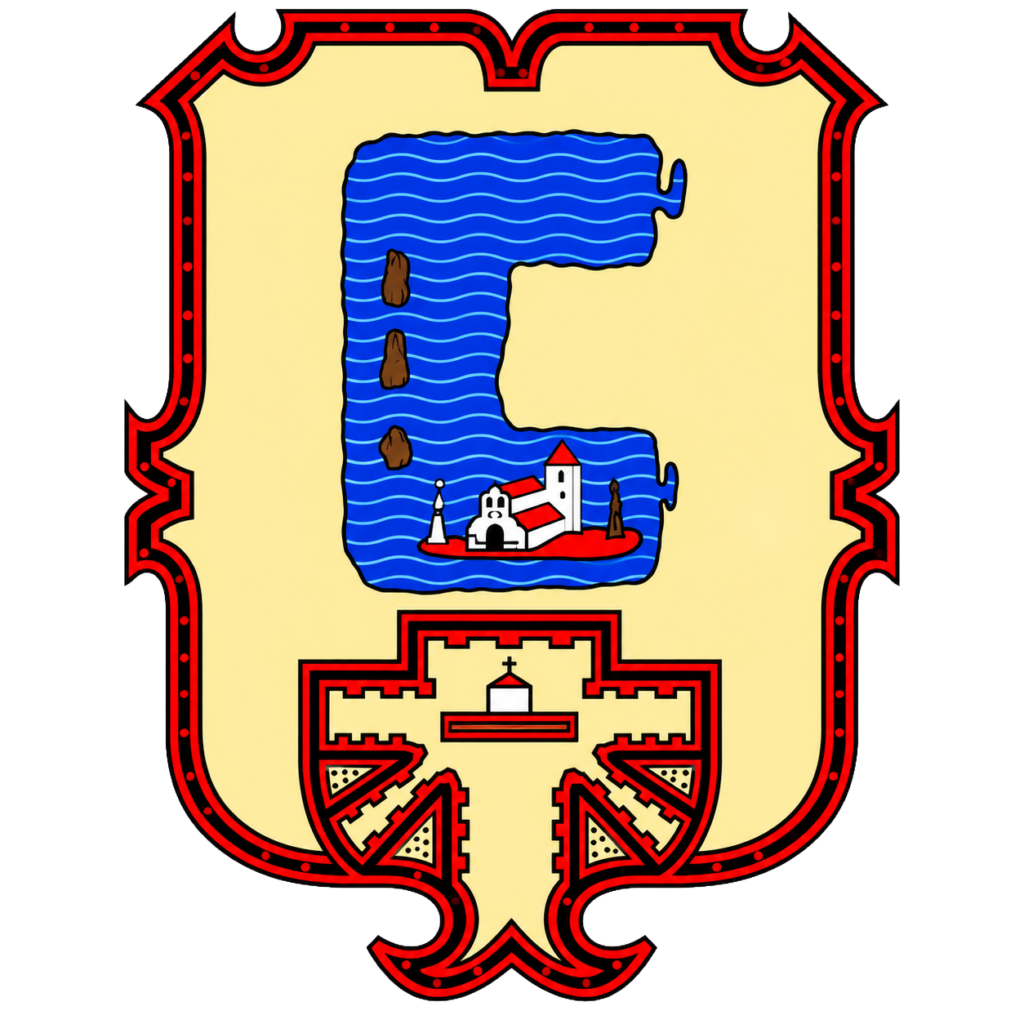
Art historian Mónica Pulido Echeveste has proposed reading these arms as a form of chorography: a representation of the city and its territory constructed through significant places.
Seen in this way, the image does not bring together buildings at random.
It connects the lake, the church on the rocky outcrop, the cathedral, and other places around the basin with the new political and religious order that Pátzcuaro was attempting to consolidate.
Pulido proposes identifying the church on the rocky outcrop with the chapel of Saint Peter and Saint Paul at Apupato, associated with Pedro Cuinierángari and Antonio de Huitzimengari.
She also interprets the other three rocky outcrops as Janitzio, Tecuén, and Yunuén..
But the distinction between document and interpretation must be preserved:
the decree speaks of a church on a rocky outcrop and of three other rocky outcrops within the lake.
It does not name them.
The specific names belong to later historiographical reconstruction, not to the text of 1553.
Antonio de Huitzimengari is also part of this story
The file allows us to correct another overly simple way of telling the past.
Juan de Oribe appeared before the Crown on behalf of the City of Mechuacan to request the granting of its own arms.
Pulido Echeveste's research connects that action with Antonio de Huitzimengari, Indigenous governor of the city and province of Mechuacan and son of Tangáxoan II.
Huitzimengari was not an ornamental figure within the new order. The documentation shows him working with corregidores and alcaldes mayores, using Spanish procurators to handle lawsuits, and taking part in building projects and political affairs in Pátzcuaro and throughout the province.
Indigenous authorities also used the legal instruments of the monarchy to defend positions, rights, and privileges.
That requires us to distribute the roles more carefully.
The coat of arms does not belong solely to a story starring Vasco de Quiroga and the Crown.
More than two centuries later, in 1766, Juan Joseph Moreno attributed a decisive role to Quiroga in negotiations carried out before the royal court.
That tradition deserves to be preserved, but so far we do not have a contemporary document from 1553 demonstrating Quiroga's direct involvement in the request for the arms.
There is therefore no need to choose artificially among Quiroga, Huitzimengari, and the municipal council.
Pátzcuaro's defense had several actors.
A coat of arms in the middle of a dispute
To understand the value of those arms, we have to look beyond Pátzcuaro.
In 1541, by order of Viceroy Antonio de Mendoza, a new Spanish settlement was founded in the valley of Guayangareo and also claimed the status of New City of Mechuacan.
Pátzcuaro maintained its own status as the City of Mechuacan.
Tzintzuntzan, meanwhile, had neither disappeared nor abandoned the privileges it claimed as the former seat of Indigenous power and the first city associated with that title.
This was not an argument over names.
To be the principal city meant jurisdiction, authorities, population, tribute, prestige, and resources.
The 1553 grant of arms gave Pátzcuaro something more than an image.
It was a royal document that could be kept alongside the city's titles and privileges.
And we know it was guarded with that level of care.
The chest a governor went out to recover
In 1577, the dispute was still alive.
A judicial testimony preserved in the Historical Archive of the City of Pátzcuaro relates that Hernán Sánchez Urdiales, a notary from rival Guayangareo, attempted to remove the three-key chest in which Pátzcuaro's Indigenous council kept some of its most important documents.
The Indigenous governor Juan Purúata reported what had happened.
According to that testimony, Purúata personally went after the chest and managed to recover it.
An inventory was then made.
Among the things it contained was the title granting the city's coat of arms..
There was also a blue damask banner bearing Pátzcuaro's arms, council books, and other royal privileges and decrees.
Purúata did not take to the road merely to recover a coat of arms.
He went to recover a substantial part of his city's legal memory.
The fact that the title to the arms was kept inside that chest helps us understand its real value.
It was not decoration.
It was one of the documents through which Pátzcuaro defended what it was.
It was also carved in stone
The arms did not remain only inside an archive.
An early representation of Pátzcuaro's coat of arms survives on the pedestal of the Christ of the Humilladero.
Around it appear the words:
“THESE ARE THE ARMS GIVEN BY THE KING”
and
“TO THIS CITY OF MECHUACAN.”
The date inscribed on another face of the pedestal is not sufficiently clear in the transcriptions we have consulted to use it here as a secure date for the monument.
And there is no need to force it.
For this story, something else matters more:
during the sixteenth century, the arms granted to the City of Mechuacan had already left the parchment and also appeared carved in stone within Pátzcuaro's own urban landscape.
If you pass by the Humilladero, it is worth stopping for a moment in front of the pedestal.
It is one of those places where an archival document reappears in the living city.
The historical coat of arms and the images that came later
A historical representation of the arms has been identified in research as Archivo General de Indias, Mapas y Planos–Escudos, 177.
That reference should be our visual starting point for studying the historical arms, rather than automatically treating a contemporary municipal version as equivalent.
As a matter of caution, we do not simply call it “the original of 1553” until the complete archival record establishing its material date and exact relationship to the grant has been examined.
The appropriate public identification is:
Historical representation of the coat of arms of Pátzcuaro. Archivo General de Indias, MP-ESCUDOS, 177.
The coat of arms carved at the Humilladero offers another early reference, this time preserved in Pátzcuaro itself.
One comes from the archive.
The other remains in the city.
And many other representations came later.
A drawing from 1792, for example, already shows a different iconographic tradition, with Saint Peter and Saint Paul represented as human figures. That helps us study how the coat of arms changed; it does not allow us to rewrite retrospectively what the decree of 1553 actually says.
The coat of arms we see today
The colors, proportions, ornaments, and details of the coat of arms changed over the centuries.
That is why not everything appearing in a modern version can be attributed directly to the original grant.
The core that can be documented in the 1553 grant is more restrained:
the lake, the church on the rocky outcrop under the invocation of Saint Peter and Saint Paul, the cathedral church, and the other three rocky outcrops.
Seen this way, Pátzcuaro's coat of arms is much more than a municipal symbol.
It is a small representation of the territory.
It is the memory of a city trying to assert itself in relation to others.
And it is also evidence of Indigenous and Spanish authorities who understood that preserving titles, images, and privileges could have very concrete consequences for a city's future.
In 1580, the episcopal seat was ultimately transferred to Valladolid.
Pátzcuaro lost that contest for institutional centrality.
But it did not lose its coat of arms.
Almost five centuries later, the lake is still there.
And those arms still tell part of the story of why Pátzcuaro sought to remain the City of Mechuacan..
 EN
EN  ES
ES