
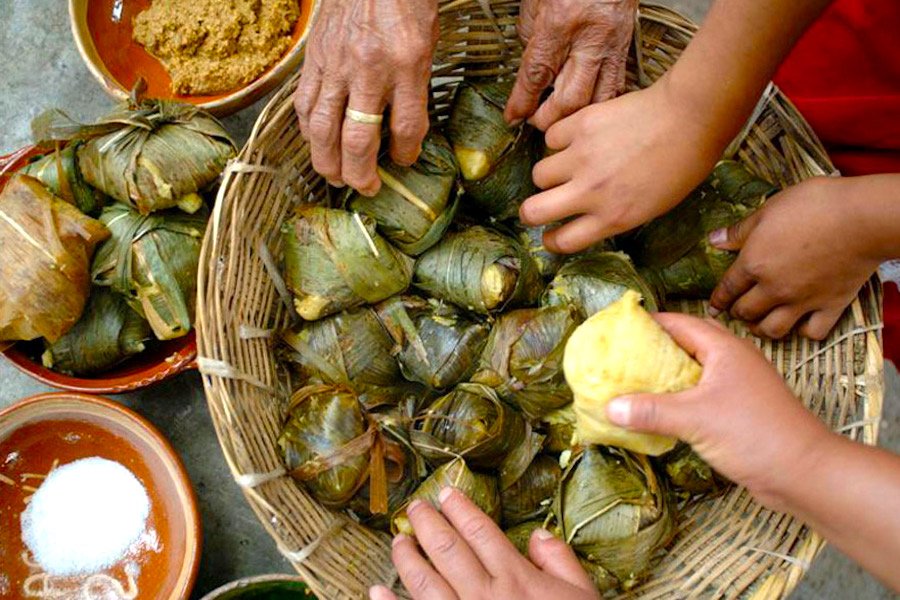
In Pátzcuaro, a table near Plaza Vasco de Quiroga, a market stall, or a small local eatery may bring together foods that did not originate in the same place.
That is not an anomaly. It is one of the keys to understanding the cuisine of the Pátzcuaro Region.
The city occupies a central place, but from here food quickly leads toward the lakeside communities, farmland, the highlands, and the roads connecting Pátzcuaro with towns such as Quiroga, Santa Clara del Cobre, Ario, Tacámbaro, and Zacapu.
That is why food deserves the same question we ask of crafts: where does it come from?
A cuisine built on relationships
In 2010, UNESCO inscribed Traditional Mexican cuisine — ancestral, ongoing community culture, the Michoacán paradigm on the Representative List of the Intangible Cultural Heritage of Humanity.
The recognition did not single out a particular dish, nor did it declare the cuisine of Pátzcuaro itself to be heritage. It encompasses an entire system: agriculture, knowledge, techniques, community practices, and the relationships that extend from growing food to preparing and eating it. Maize, beans, and chile are part of that foundation, together with the milpa and processes such as nixtamalization.
The fact that it is a living tradition also means that it has changed. Ingredients, tools, and ways of cooking have been incorporated and transformed over centuries. Rather than searching for a cuisine frozen in time, it is more useful to recognize what continues, what has changed, and who keeps that knowledge alive.
Maize also draws a map
Diversity begins before food ever reaches the kitchen.
Research carried out between 2012 and 2015 identified eleven maize races in the Lake Pátzcuaro region. Among the communities with the greatest diversity were San Andrés Tziróndaro, Arócutin, Uricho, Tzurumútaro, Napízaro, and Pichátaro. The study also shows how different varieties relate to elevation, soils, moisture, and distinct forms of agriculture.
That helps explain why simply speaking of “Michoacán maize” tells us so little.
A corunda, an uchepo, an atole, or an atápakua may share ingredients and techniques, yet change from one household to another and from one community to the next.
Las Atápakuas are a good example. A bilingual cookbook published in 2004 brought together 42 variations from four communities near Lake Pátzcuaro, prepared with different combinations of vegetables, seeds, wild greens, meats, and fish.
The same name does not always mean exactly the same dish.
Pátzcuaro: a table and a meeting place
Pátzcuaro also has culinary stories of its own.
According to the Oseguera family’s memory, Tarascan soup began being served in 1966 at Hostería de San Felipe. It is a widely repeated family genealogy, but we do not currently have documentation from that year that would allow us to present it as a historically proven origin.
La Nieve de pasta ikewise belongs to the everyday landscape of the city. Its exact origin is told in different ways, but its presence around Plaza Vasco de Quiroga is deeply associated with Pátzcuaro. Establishing a date or naming an inventor as fact would require documentation we do not yet have.
And in Pátzcuaro and Janitzio we find another small map inside a drink: atole de chaqueta, made with maize dough, piloncillo, and cacao husk.
Cacao does not grow in the highlands around the lake.
That too can be the beginning of a story: ingredients travel.
The market tells the story of the region
The market in Pátzcuaro makes these relationships visible without needing much explanation.
El mercado de trueque or barter market, brings together goods carried mainly by residents of communities near the lakeshore. Studies of the practice describe it as a place of exchange and provisioning for farmers, fishers, and artisans. The practice continues in the new market, where fish, fruit, seeds, plants, and other products still arrive from the surrounding communities.
Pátzcuaro brings part of those exchanges together; it does not originate them all.
That distinction matters.
When the road changes, so does the table
The Pátzcuaro Region does not end at the lakeshore.
AroundToward Santa Clara del Cobre, the torta de tostada is a characteristic preparation of the town and is explicitly recognized among the foods associated with its local cuisine.
Farther south, Tacámbaro has its own tradition of carnitas, but it also leads us to something even more deeply rooted in place: the Bola de Pedernales. Available documentation connects its history with agricultural workers during the Porfirian period: beans with guajillo chile and different stews are wrapped inside warm tortillas to form a ball that helps retain the heat. That reconstruction comes from local research later cited by institutional sources; for now, that is the degree of certainty we can responsibly sustain.
In Ario de Rosales, olla podrida, cocada, and mezcal production also have a presence of their own.
And in Zacapu, nieve de pasta has acquired a life of its own. What we still cannot establish as fact is the genealogy that would trace its arrival from Pátzcuaro through relatives or apprentices.
These examples are not intended to form a complete list.
They simply remind us that each town contributes something different to the regional conversation.
The lake on the table
Within this broader region, the lake forms a territory of its own.
Charales and whitefish are part of its culinary history. Speaking about them today also means acknowledging the ecological and fishing changes that have affected the basin.
Natural populations of whitefish have declined severely, and breeding and aquaculture programs have been developed to support their recovery. For that reason, seeing “whitefish” on a menu is not enough to know which species it is or where it came from.
Asking does not diminish the experience: it helps us understand it.
Eating is also a way of traveling
The cuisine of the Pátzcuaro Region cannot be reduced to a list of “typical dishes.”
It is found in a maize field in Tzurumútaro or Uricho; in an atápakua that changes from one community to another; in the barter market of Pátzcuaro; in a nieve beneath the arcades; in the torta de tostada of Santa Clara; in a Bola de Pedernales; in the olla podrida of Ario; in the lake, and in what the lake can no longer produce as it once did.
Pátzcuaro is a place from which these threads can begin to come together, but the region has many voices, and each place should keep its own..
When something arrives at your table, it is worth asking:
What is it called?
Who prepared it?
Where does it come from?
Sometimes the answer is only a few streets away.
Other times, it means taking the road.
For a deeper look at recipes, techniques, cooks, and individual preparations, the conversation continues in Experiencia Pátzcuaro.
 EN
EN  ES
ES