
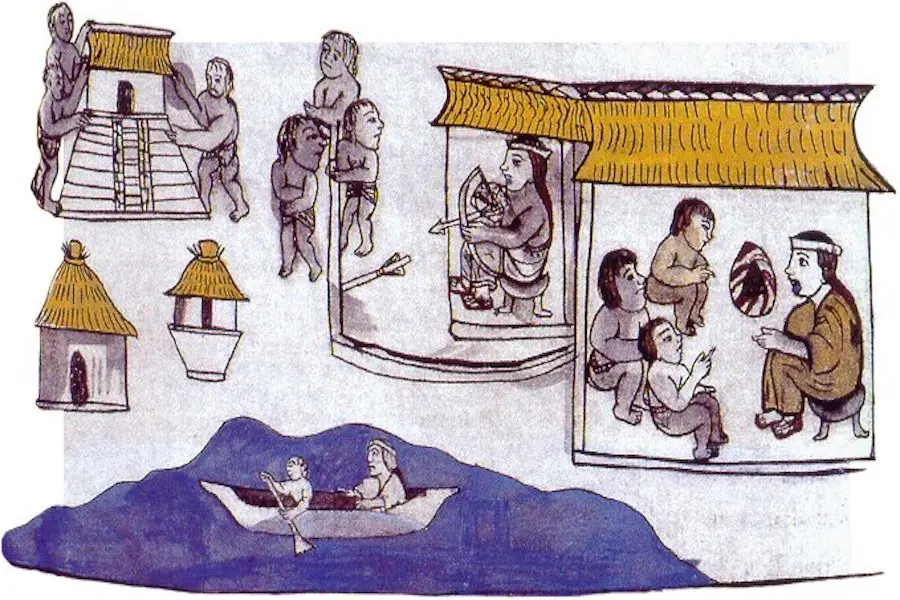
The Enigma of the Name The word “Pátzcuaro” is much more than a name; it is a concept that encapsulates the mystique of the region. Although linguists and historians have debated its origin for centuries, proposing meanings such as “Place of foundations” (Petatzecuaro) or “Place where they dye black,” the most profound interpretation is found in the Relación de Michoacán.
According to this fundamental historical document, the original name was Tzacapu-Arocutin-Patzcuaro, which translates as “The Gate of Heaven” or “Where the entrance to paradise is”. For the ancient inhabitants, Lake Pátzcuaro was the sacred threshold where life and death met, the geographical point where the gods ascended and descended.
The Founding Legend (1324 AD) Official history is intertwined with legend. It is said that around the year 1324, the Chichimec chieftains Páracume and Vápeani, guided by the will of their ancestors, found four large rocks together at this site.
For them, the number four was sacred, a symbol of the cardinal directions and the Southern Cross constellation. In that neighborhood, which they called Tarimicundir, they decided to settle their tribe and build their first temples, thus marking the birth of what we know today as Pátzcuaro.
The Purépecha Empire: A Unique Civilization Often overshadowed in textbooks by the Aztecs, the Purépecha were a formidable and advanced civilization. Unlike other Mesoamerican peoples, they had already mastered the use of copper and bronze for weapons and tools, making them virtually unbeatable warriors; in fact, the Aztecs (Mexica) never managed to conquer them.
Under the reign of the great King Tariácuri, the empire was consolidated through a strategy of three capitals or “Triple Alliance”:
- Pátzcuaro: The Religious Capital, home of the Cúes (temples) and spiritual heart.
- Tzintzuntzan (Place of Hummingbirds): The Political Capital, from where power was administered.
- Ihuatzio: The Military Capital, bastion of defense of the empire.
Is it “Tarasco” or “Purépecha”? It is common to hear both terms, but there is an important difference. The natives of the region proudly call themselves P’urhépecha (which means “People” or “Person”).
The term “Tarasco” arose from a linguistic misunderstanding during the arrival of the Spanish. The most widely accepted theory indicates that it comes from the indigenous word *tarascue*, which means “son-in-law” or “brother-in-law.” The indigenous people used this word to refer to the Spaniards with whom they became related by marrying their daughters. The conquistadors, not understanding the language, mistakenly assumed that this was the name of the people.
The Twilight and the Hope The last Cazonci (supreme ruler), Tangaxoan II, witnessed the end of an era. After the arrival of the Europeans, the region suffered the barbarity of conquerors like Nuño de Guzmán, who in 1529 devastated the indigenous social structure, sowing chaos and dispersing the population towards the mountains.
Parecía el fin de la historia para esta gran cultura, hasta que la Corona Española envió en 1533 a un hombre cuya visión humanista cambiaría el destino de Michoacán para siempre: Don Vasco de Quiroga.
 EN
EN  ES
ES