
A name that cannot be contained in a single translation
Pátzcuaro has carried so many names and interpretations across the centuries that any single, tidy translation deserves a little caution.
Mexico's National Institute of Anthropology and History records one interpretation of the name as a “seat of temples.”Michoacán historian Ricardo Carvajal Medina, working from sixteenth-century sources, vocabularies and grammars, has proposed a reading of the older Zacapu Hamúcutin Pátzcuaro close to “The Stone on the Shore Where They Dye Black.”These interpretations come from different readings of the historical evidence; neither should simply be presented as the one unquestionable meaning of the name.
Then there is a phrase that generations in Pátzcuaro have known well:
Gate of Heaven.
An important distinction is needed here. “Gate of Heaven” is not a demonstrated translation of the word Pátzcuaro.But neither is it merely a modern tourist invention.
La Relación de Michoacán, compiled from Indigenous testimony, records that the previous cazonci said that this place—and no other—was the gate of heaven through which their gods descended and ascended. The same passage says that the site was held in great veneration and associated with Curicaueri.
So perhaps the most faithful way to put it is this:
Pátzcuaro does not simply mean “Gate of Heaven.” Pátzcuaro was remembered and described as a gate of heaven.
That difference matters.
Tarímichúndiro, the rocks and four stones
Ancient Pátzcuaro does not begin with a date written on a founding document.
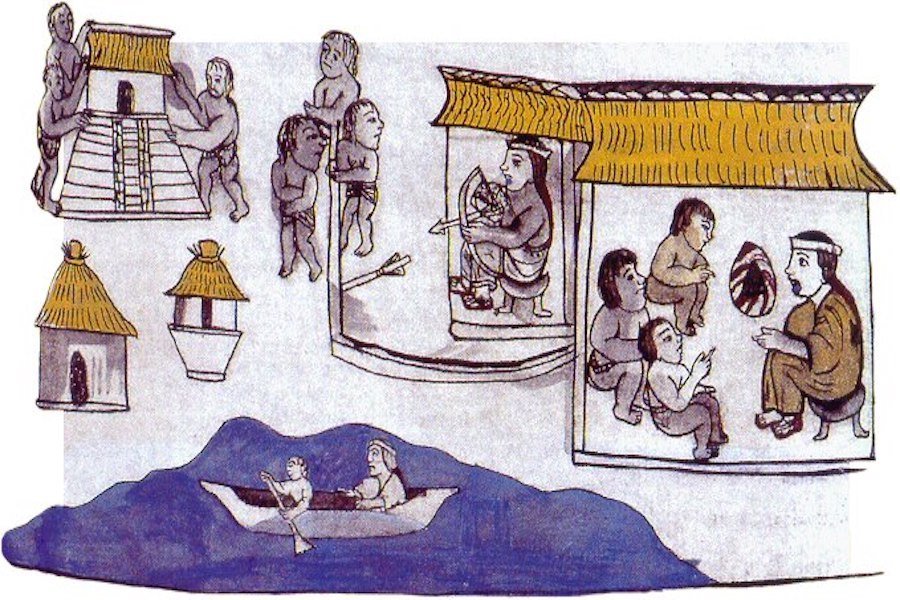
La Relación de Michoacán places Pauácume and Uápeani at Tarímichúndiro, que identifica como un barrio de Pátzcuaro. Desde allí se desarrolla el relato del descubrimiento del lugar destinado a los cúes o templos.
Among them were the petázequa: elevated rocks upon which temples were built. The Relación glosses them as a “seat of a temple.” They were part of the landscape itself, not simply “foundations” in the modern architectural sense.
And here the source preserves a remarkable detail.
There were four upright stones, resembling unworked idols. The account names them—with spelling variations among editions—as Zirita-cherengue, Uacúsecha, Tingárata and Miequa-axcua, y dice expresamente que eran cuatro dioses.
We do not need to add a modern symbolism that the source itself does not provide.
The four stones already tell quite a story.
It is a very different way to imagine the birth of a city.
Not an empty piece of land.
A landscape read, recognized, and imbued with meaning.
What about 1324?
For decades, 1324 has been repeated as the year Pátzcuaro was founded.
That date belongs to the city's historical and civic tradition and should not simply be erased. But so far, we have not located its original documentary source.The exact historiographical origin of 1324 remains unresolved for now.
Las reconstrucciones de los historiadores suelen situar este proceso uacúsecha en el fourteenth century, and INAH likewise dates the city’s pre-Hispanic antecedent to that century. But this approximation should not be confused with a date actually recorded in the Relación de Michoacán.
So at Visit Pátzcuaro, we prefer to say what we actually know:
1324 is Pátzcuaro’s traditional founding date. The historical process can be placed approximately in the fourteenth century; the exact year remains open to research.
Some cities begin with a document.
Pátzcuaro appears earlier among water, rock, forest, power, memory and story.
Pátzcuaro before the streets we know
Traces of that earlier city still remain beneath and within the city we know today.
If you walk around the present-day Museum of Arts and Popular Industries and other buildings in the historic center, you are crossing an area where archaeological research has identified platforms and foundations belonging to the ancient settlement.
La Relación de Michoacán also preserves an extraordinarily concrete detail. Even after the political seat had moved elsewhere, Pátzcuaro still had three cúes, three hearths and three priests’ houses, arranged around a prepared courtyard, and offerings continued to be brought to the site.
That helps explain why Pátzcuaro did not disappear when political power moved.
Its importance did not depend solely on who ruled from there.
Three seats of power, not three labels
For a long time, an easy formula has been repeated: Pátzcuaro as the religious capital, Ihuatzio as the military capital and Tzintzuntzan as the political capital.
It works as a tourist shorthand.
History is more interesting.
La Relación de Michoacán and archaeological research show that, after Tariácuri, Pátzcuaro, Ihuatzio and Tzintzuntzan functioned as three principal seats of power. Hiquíngare was associated with Pátzcuaro; Hiripan with Ihuatzio; and Tangáxoan with Tzintzuntzan.
Their relationships changed over time.
Ihuatzio experienced a period of considerable importance under Hiripan. Later, Tzintzuntzan increasingly concentrated power and eventually became the capital of the polity encountered by the Spaniards in the sixteenth century. Pátzcuaro, meanwhile, retained ceremonial importance and a religious memory that the sources themselves continued to record.
They were not three perfectly separate compartments.
They were cities connected through lineage, warfare, alliances, worship and power, and their functions changed over time.
Purépecha and Tarascan: words have histories too
Visit Pátzcuaro normally uses purépecha.
INALI records p’urhepecha and p’orhepecha as self-designations and “purépecha” as the Spanish-language name. At the same time, historical documents and much older scholarship us Tarascan.
So we will not erase “Tarascan” from books or historical sources.
When it appears, we will explain where it comes from.
And when speaking in our own voice, we will prefer purépecha.
The Conquest changed the world, but did not erase everything that came before
In 1522, Tangáxoan II chose to avoid open war with the Spaniards and entered into a political relationship with the new power.
That did not prevent the violence that followed.
El February 14, 1530, Tangáxoan II was executed after proceedings ordered by Nuño de Guzmán.
Vasco de Quiroga came to Michoacán in 1533, still serving as a judge of the Second Audiencia. He was appointed bishop of Michoacán later in the decade and formally took possession of the diocese in Tzintzuntzan on August 6, 1538. The following day, part of his entourage, priests and civil authorities moved to Pátzcuaro, beginning a process in which the episcopal seat and political centrality shifted there.
But that story was not the work of one man alone.
The transfer met resistance in Tzintzuntzan, led to conflicts over the rank and rights of both communities, and opened a dispute that continued for decades. Indigenous nobles and authorities took an active part: some supported Pátzcuaro’s project, while others defended the rights of Tzintzuntzan.
The colonial city thus grew over, around and alongside an earlier Indigenous city, not upon empty ground.
In 1553, Charles V granted Pátzcuaro its coat of arms, whose image of the lake and the projected cathedral still preserves the memory of that period.
But beneath the sixteenth-century city, another city remained.
In the stones.
In the names.
In the lineages.
In the communities.
And also in the way the place continued to be remembered.
So when someone asks:
How did it all begin?
the answer cannot fit into a single date.
You have to walk a little farther.
 EN
EN  ES
ES